

Morgan Stanley Report: Is the Swiss Watch Industry in Crisis?
As they do every year, Morgan Stanley and LuxeConsult have re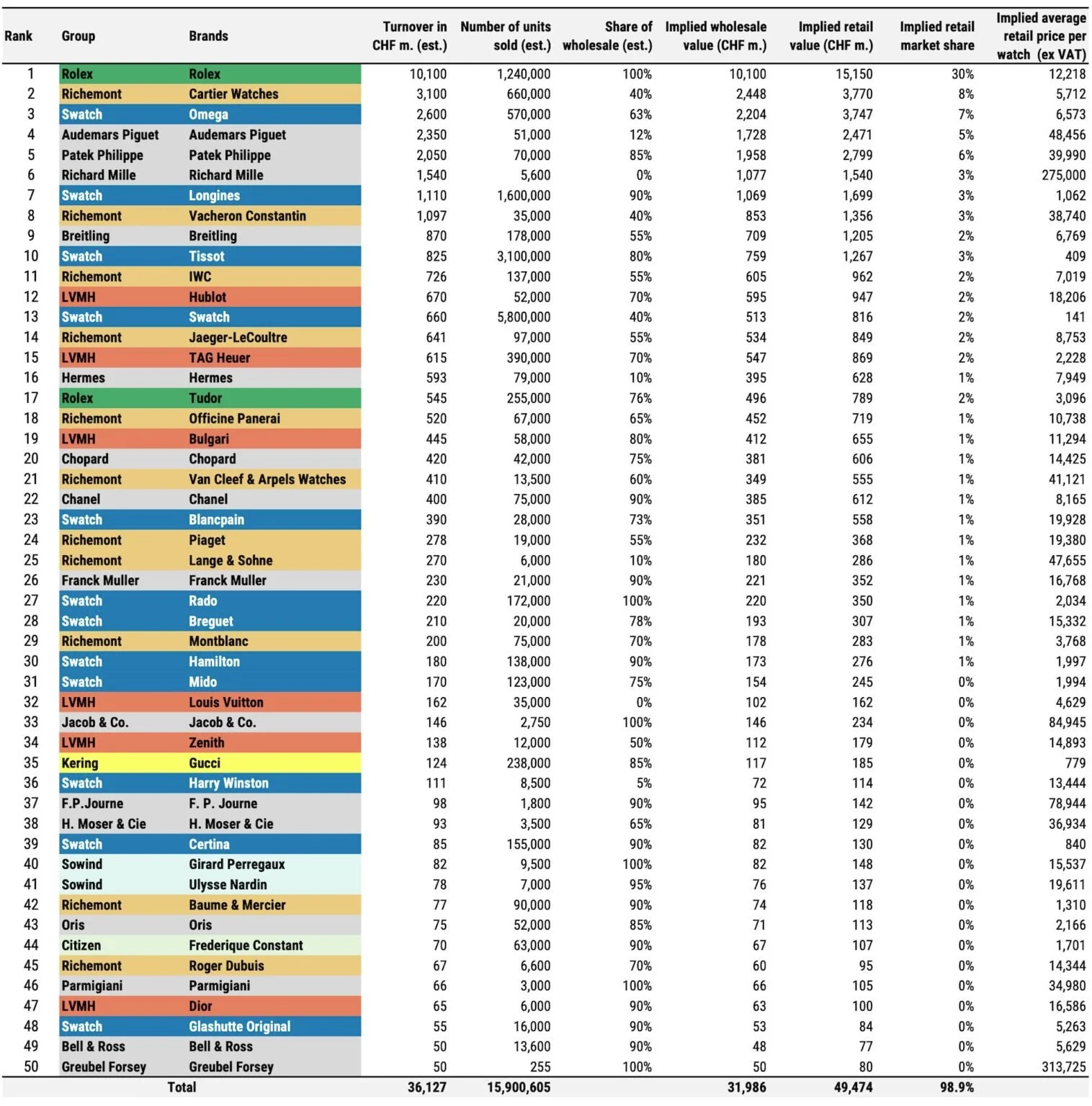 leased their annual report on the Swiss watch industry. This time, it reveals a clear shift in the market. After years of record growth, the industry appears to be facing a noticeable slowdown, although not everyone is affected equally.
Declining sales and rising prices
According to the report, total sales among the top 50 brands fell from CHF 36.1 billion to CHF 35.2 billion, while the number of watches sold declined from 16 million to just 13 million. This does not mean the industry is collapsing. Rather, the average watch price has risen significantly, reflecting a shift towards luxury watches at the expense of the mid-priced segment.
Rolex continues its undisputed dominance
Despite the broader slowdown, Rolex strengthened its position as the market's largest player, with revenue exceeding CHF 10.5 billion, an increase of CHF 500 million over the previous year. Together with Patek Philippe, Audemars Piguet and Richard Mille, these brands now account for 47% of the overall market, reflecting significant changes in customer preferences.
Major groups under pressure, with Swatch hit hardest
The picture was less positive elsewhere. Swatch Group recorded a 14.6% decline in sales, while LVMH and Richemont lost some market share despite strong performances from brands such as Cartier and Bulgari. Omega, which remains among the top three brands, was also affected by Swatch Group's weaker overall performance.
Luxury watches continue to rise
One clear winner is the luxury watch segment. According to the report, watches priced above CHF 50,000 represented 33.5% of total export value and accounted for 84% of growth in 2024. Independent brands such as F.P. Journe, H. Moser & Cie. and MB&F also continued to make progress, with MB&F entering the list of influential brands for the first time.
What is happening with Tudor?
Tudor was among the brands that had a less fortunate year, delivering a weaker performance than expected according to the report's estimates. Possible reasons include pricing, model availability and changing customer interests. Further observation is needed to determine whether this is a temporary slowdown or the start of a more challenging period of competition.
Where is the watch industry heading?
The most striking aspect of the report is not simply the rise or fall in sales, but the clear trend towards a market concentrated in the hands of fewer major players. Meanwhile, mid-range brands appear to face growing pressure as watch prices rise and buyers' priorities change. Is this a temporary correction after years of growth, or is the industry entering a new phase of polarization?
What do you think? Will the market recover in 2025, or will luxury brands continue to dominate? Share your thoughts! ⌚🔥 #WatchWatcher